
The project
- Product
- Arus, at arus.cx
- First operator
- ACS Bali Foundation, a waste company serving hospitality in Bali
- Our role
- Product design and full-stack engineering
- Timeline
- Built July to October 2026, now in pilot
- Stack
- Next.js, Supabase, Better Auth, Google Gemini
- Services
- Custom software, AI and automation
Key takeaways
- Arus puts daily waste data and weekly separation audits on one dashboard, because residue is the result of how well a team separates.
- Every failed audit check needs a photo, gets an independent AI second opinion, and becomes an action due within 7 days.
- It's built for more than one waste company: streams, checklists, pass marks and branding belong to the operator.
- Arus is in pilot with ACS Bali Foundation, after about twelve weeks of design and build and 1,800+ automated test cases.
What is Arus?
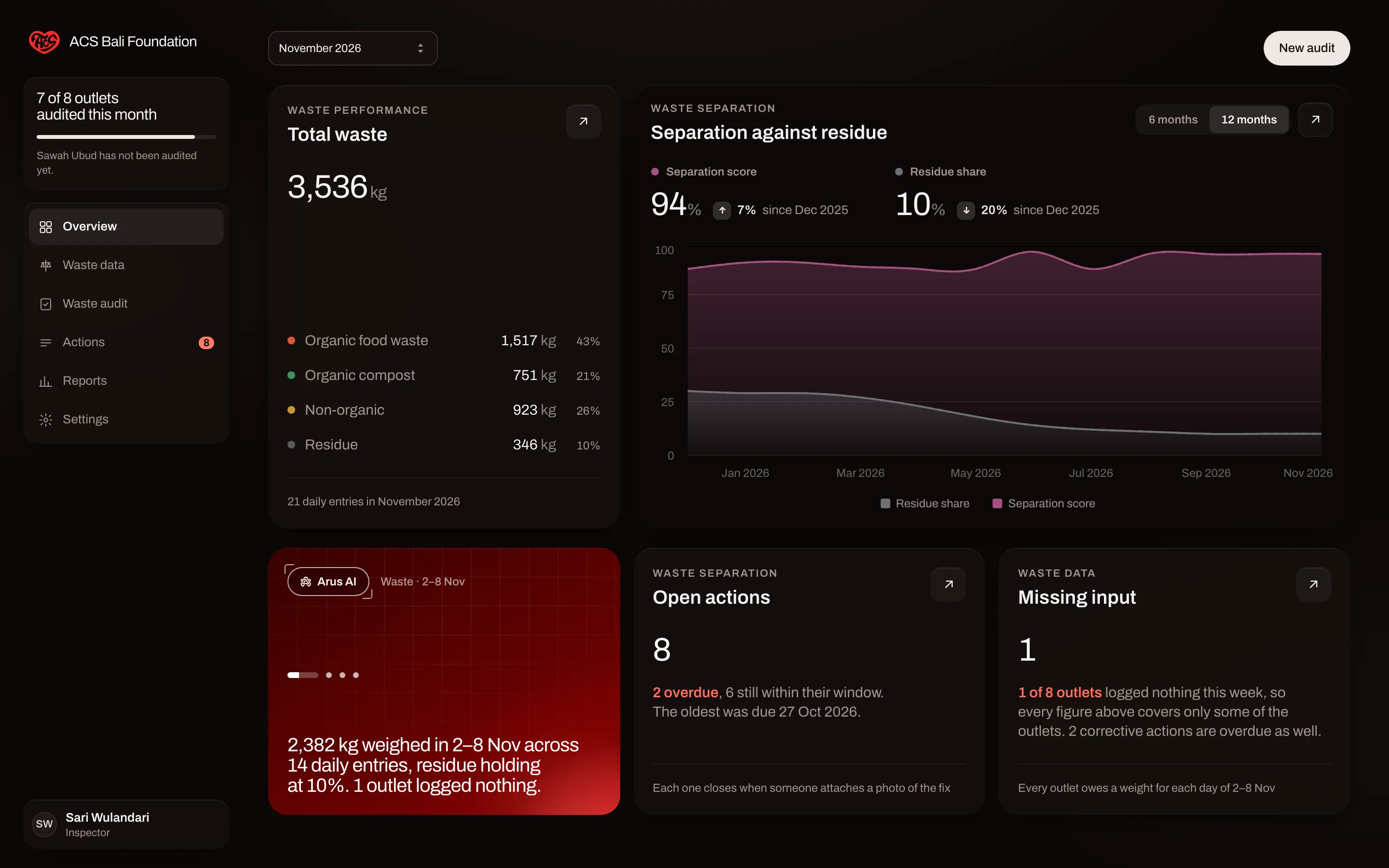
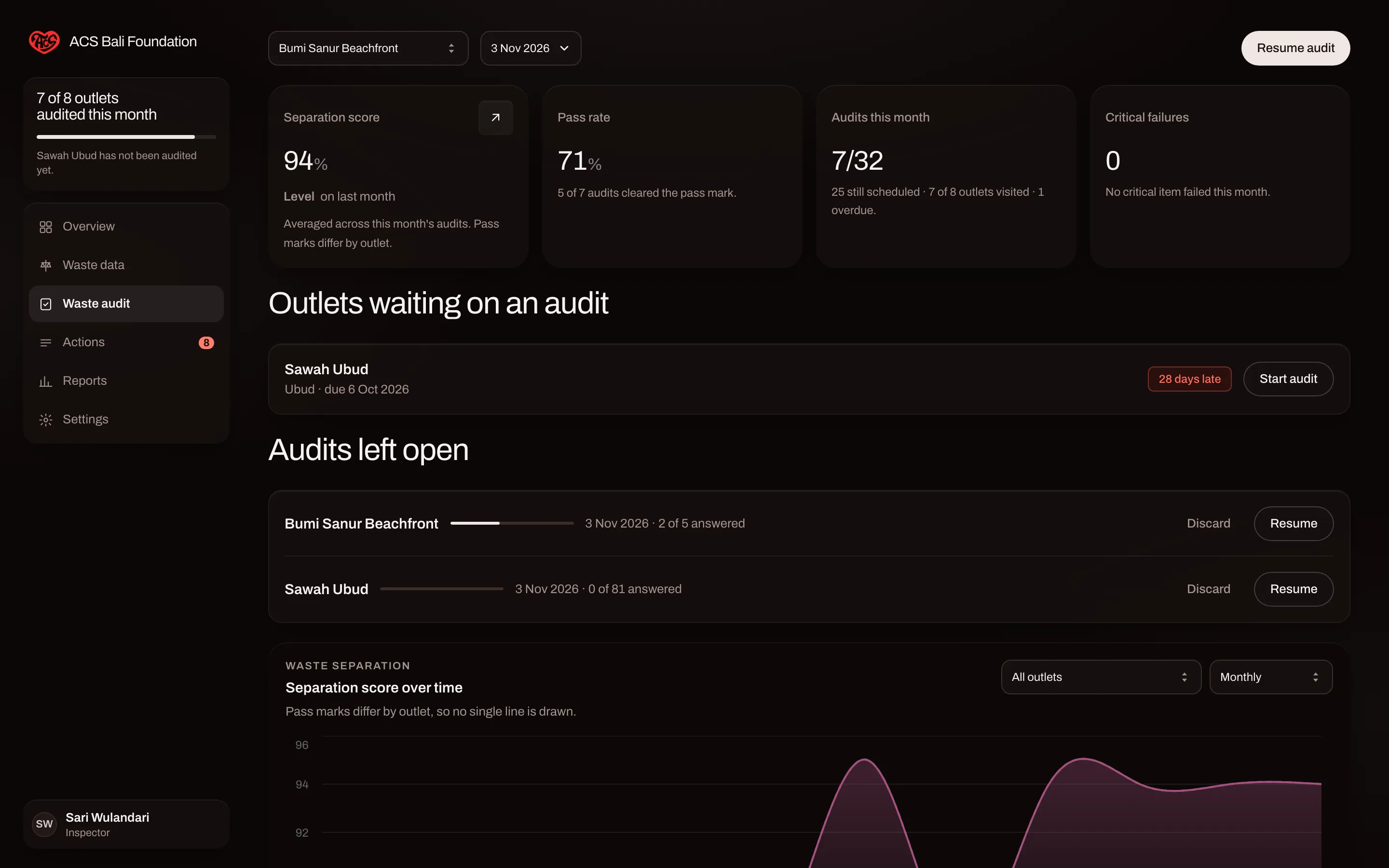
Arus is waste-management software for multi-outlet hospitality in Indonesia. It gives a waste company, and the hotels and restaurants it serves, two systems on one dashboard: waste data recorded daily per bin and outlet, and separation audits run weekly on a tablet.
Its first operator is ACS Bali Foundation, an Indonesian waste company with hospitality clients across Bali. Digics designed and built the platform between July and October 2026, and it's now in pilot as ACS starts bringing its clients on.
Why put waste data and audits in one place?
Because one explains the other. Of the four streams Arus tracks, residue is the only one that can't be recycled, and how much residue a kitchen produces is decided by how well its staff separate. ACS's own argument, from the start of the design, was that a high residue share is the symptom and a poor separation score is the cause.
So the overview plots both on one chart: separation score against residue share, month by month. When the score climbs and residue falls, the connection is visible rather than asserted. When residue rises, the audits that explain it are one click away.
How is waste recorded?
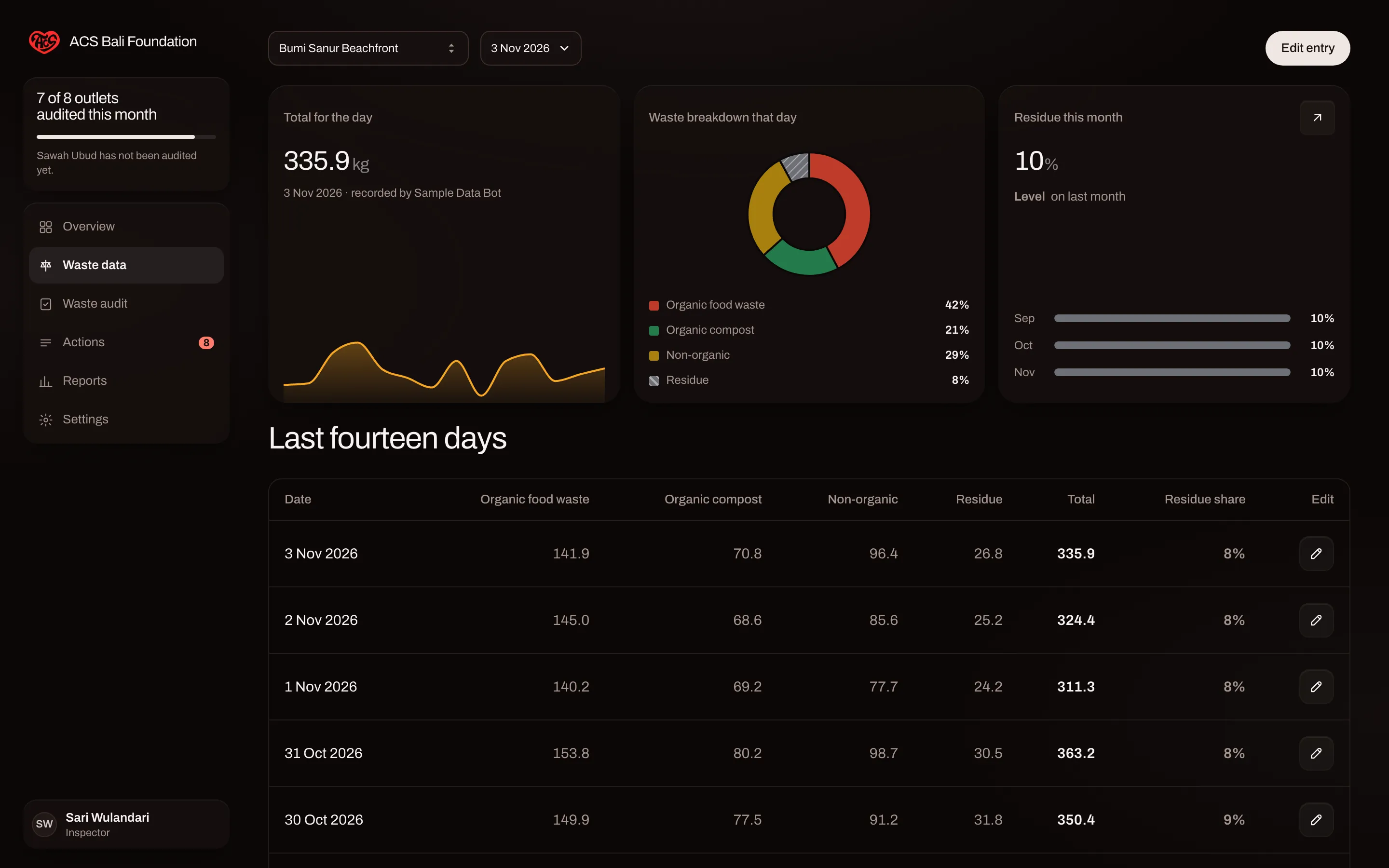
Each outlet's waste is weighed daily across four streams, each with its own destination:
- Organic food waste, which goes to a pig farm as feed.
- Organic compost, for composting.
- Non-organic, sorted for recovery.
- Residue, the part nothing can be done with, which goes to incineration.
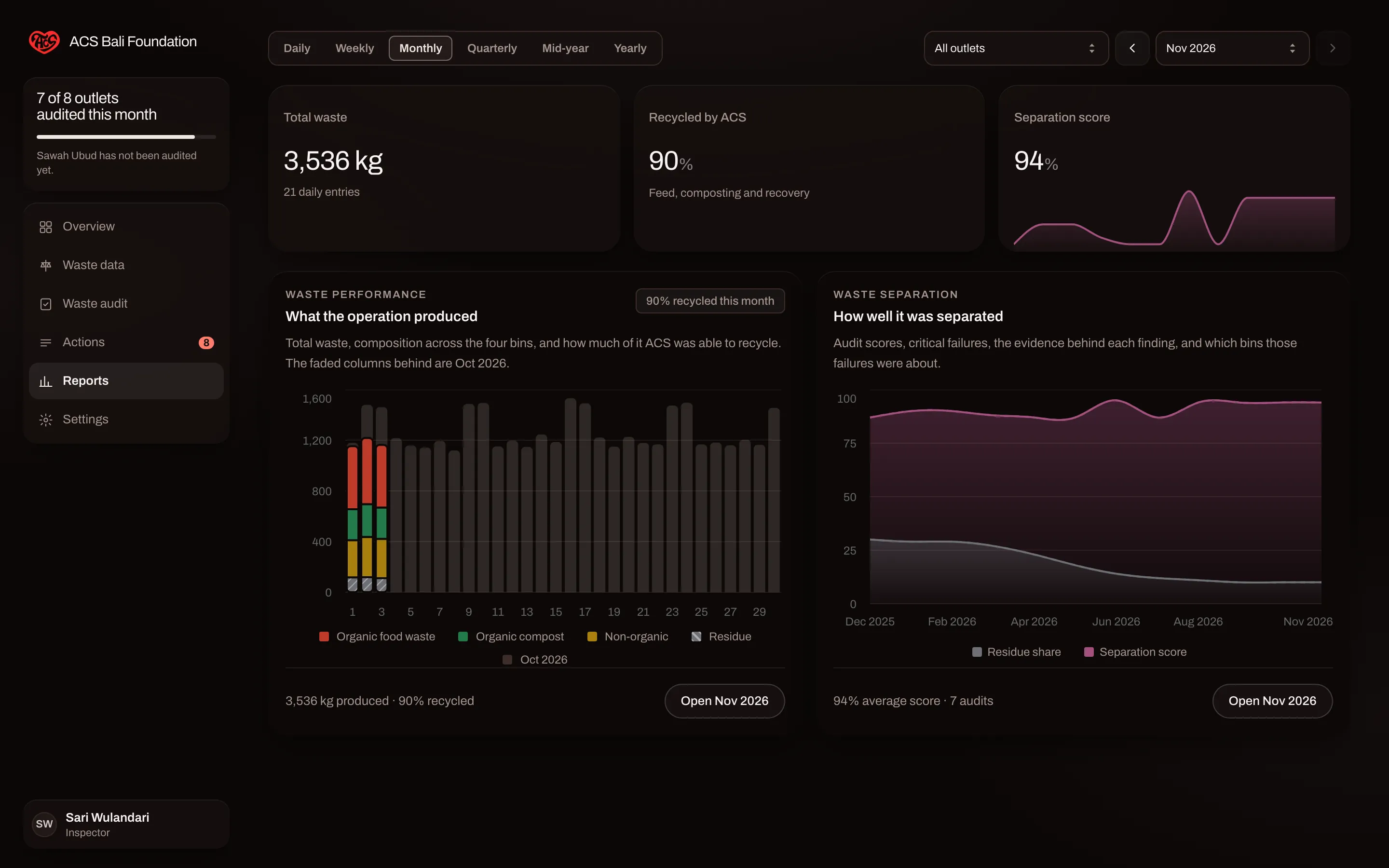
Entering a day again replaces it rather than adding to it, so a day is only ever counted once. From those entries, Arus works out each outlet's composition and how much of its waste the waste company was able to recycle, at any period from a day to a year.
How does a separation audit work?
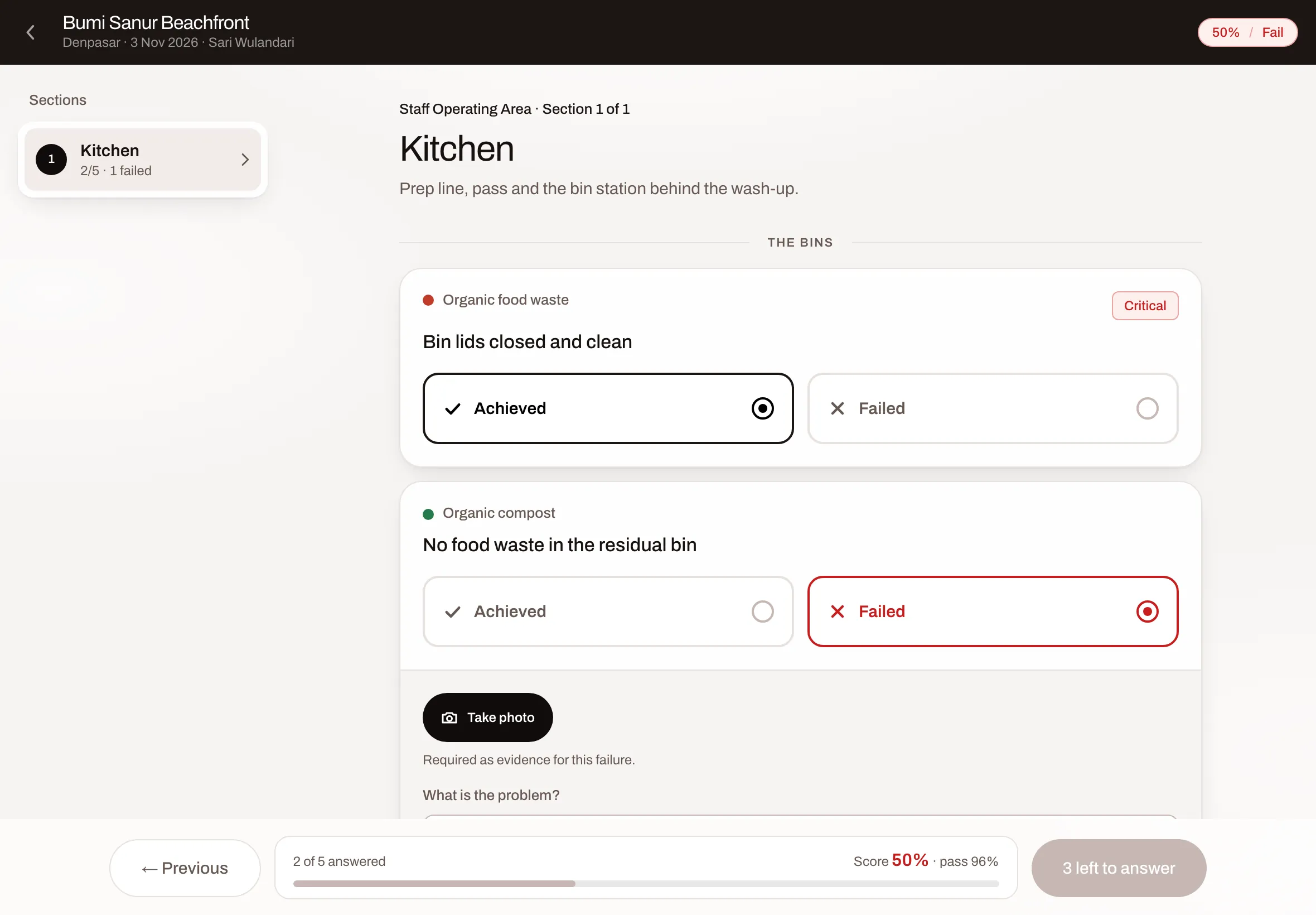
An inspector walks the outlet with a tablet, section by section and bin by bin. Each check gets one of two large answers, Achieved or Failed, sized for a thumb rather than a mouse. A failure opens a camera and a note, and the photo is required: no evidence, no failed check.
The score is the share of answered checks that passed, and the outlet passes when it clears its own pass mark with no critical failures. Pass marks are set per outlet, because a hotel kitchen and a beach bar don't fail in the same ways.
What does the AI second opinion do?
Each failure photo goes to Google Gemini for an independent read of what's in the bin. The model never sees the inspector's verdict, and it doesn't hand down one of its own: it reports what it detects, and the verdict is calculated in code from that. The review runs from a queue, off the inspector's screen, so an audit never waits on it.
Early testing showed why that design matters. In one evaluation photo, a model labelled styrofoam as rice. The fix was to make it describe the material it can see before it names the item, and to change the model; after that change it identified the styrofoam correctly in all four test runs. We'd rather an AI admit what it sees than guess what something is.
What happens after a failed check?
Every failure becomes a corrective action with an owner and a due date fixed seven days out, which is when the next weekly audit comes round. An action only closes with a photo of the fix, so "done" means the same thing to the waste company and the venue.
- Outstanding, overdue and closed actions are counted at the top of the board.
- Overdue actions surface on the overview next to the outlets that haven't logged their waste.
- Reports cover a day, a week, a month, a quarter, half a year or a year, and print to PDF for the client.
Who can see what?
Arus is multi-tenant in four levels: the platform, the waste company, its client businesses, and their outlets. Each person's access says where they can act and with what authority, from read-only viewer to admin, so a hotel group's head office sees all its outlets while a venue supervisor sees one.
Each waste company runs Arus under its own brand, on its own address, with its own streams, colours, checklists and pass marks. ACS is the first, but another waste company, or a hospitality group running its own collection, is just another tenant. Partners can also connect through a REST API with keys, rate limits and sandbox accounts, still marked as unstable while it settles.
Which technology runs Arus?
Arus is a Next.js application with Supabase underneath, hosted on Vercel, with the database and photo storage in Singapore, close to its users.
- App: Next.js and React, Tailwind CSS and Base UI, in a Turborepo with shared packages for the business rules and design tokens.
- Data: Supabase Postgres, queried with Kysely and plain SQL, plus Supabase Storage for audit photos.
- Auth: Better Auth, with roles and scopes checked on every query.
- AI: Google Gemini for photo review, run from a queue.
- Tests: more than 1,800 automated test cases, many of them running against a real Postgres database.
What's next for Arus?
The pilot comes first: bringing ACS's hospitality clients onto the platform and learning from real audits rather than sample data. On the build side, the AI review queue needs to run on a schedule, the interface is English-only while many of the people using it day to day work in Indonesian, and a native tablet app with offline audits is planned but not built yet.
Arus in numbers
Arus is in pilot, so these are facts about how it's built and how it behaves, not usage figures.
Source: the Arus codebase and project history, November 2026. Screens on this page show the app's demo data, with fictional outlets.
Questions
Waste companies that serve hotels, restaurants and bars, and hospitality groups that run their own collection. It's built for operators with many outlets, where both the volume of waste and how well it's sorted need tracking per venue.
No. The inspector decides. The AI gives an independent second opinion on the photo of a failure: it reports what it sees in the bin, without seeing the inspector's verdict, and Arus works out from that whether it agrees.
Yes, that's how it's built. Streams, checklists, pass marks, colours and the brand belong to the operator, so a second waste company runs as its own tenant on its own address. ACS Bali Foundation is the first.
About twelve weeks from the first demo on 26 July 2026 to the version in pilot today. ACS reviewed the first demo three days after it was built, and the multi-tenant platform, the reports and the partner API followed over August and September.
Yes. Arus is the kind of operational software we design and build end to end: data entry that fits the people doing it, rules enforced in code and reports clients can read. See our custom software development and AI and automation services.